

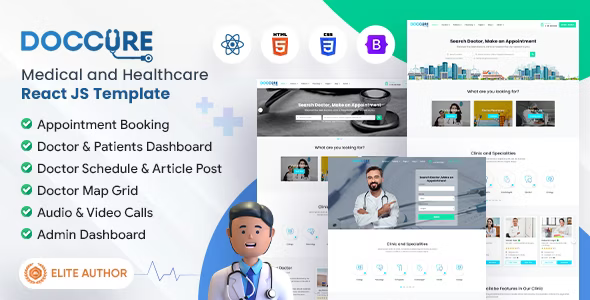
- React 19 + TypeScript + Vite
- Fast, modern stack for web applications
- Redux Toolkit
- Rich UI components and utilities
- Bootstrap 5.x used
- Uses React.lazy & Suspense for performance
- Custom Hooks For theme, debouncing, and more
- Dynamic RTL/LTR switching with custom overrides
- Feature-based organization for easy scaling
- All custom tweaks in src/assets/scss/ and src/assets/css/
- Charts & Widgets
- Fully Responsive
- Compatible with all modern browsers
Project Overview
The project follows a modular structure with clear separation of concerns.
doccure_react/
└── template/
    ├── admin/                       # Admin React Project
    │   ├── public/
    │   ├── src/
    │   │   ├── assets/
    │   │   │   └── scss/
    │   │   │       └── custom.scss
    │   │   ├── components/
    │   │   ├── core/
    │   │   │   ├── data/
    │   │   │   ├── json/
    │   │   │   └── redux/
    │   │   ├── hooks/
    │   │   ├── layouts/
    │   │   ├── pages/
    │   │   ├── routes/
    │   │   ├── types/
    │   │   ├── utils/
    │   │   ├── i18n.ts
    │   │   ├── environment.tsx
    │   │   ├── main.tsx
    │   │   ├── setupTests.ts
    │   │   ├── vite-env.d.ts
    │   │   └── __tests__/
    │   ├── package.json
    │   ├── tsconfig.json
    │   ├── vite.config.ts
    │   └── README.md
    │
    ├── frontend/                    # Frontend React Project
    │   ├── public/
    │   ├── src/
    │   │   ├── assets/
    │   │   ├── components/
    │   │   ├── core/
    │   │   ├── hooks/
    │   │   ├── layouts/
    │   │   ├── pages/
    │   │   ├── routes/
    │   │   ├── types/
    │   │   ├── utils/
    │   │   ├── i18n.ts
    │   │   ├── environment.tsx
    │   │   ├── main.tsx
    │   │   └── __tests__/
    │   ├── package.json
    │   ├── tsconfig.json
    │   ├── vite.config.ts
    │   └── README.md
    │
    └── pharmacy/                    # Pharmacy React Project
        ├── public/
        ├── src/
        │   ├── assets/
        │   ├── components/
        │   ├── core/
        │   ├── hooks/
        │   ├── layouts/
        │   ├── pages/
        │   ├── routes/
        │   ├── types/
        │   ├── utils/
        │   ├── i18n.ts
        │   ├── environment.tsx
        │   ├── main.tsx
        │   └── __tests__/
        ├── package.json
        ├── tsconfig.json
        ├── vite.config.ts
        └── README.md
Structure Overview
The src/utils/ directory contains reusable utility functions organized by category for easy maintenance and development.
src/utils/
├── constants/                  # Application constants and configuration
│   ├── api.ts                 # API endpoints and configuration
│   ├── app.ts                 # App-wide constants and settings
│   └── index.ts               # Barrel export
├── formatters/                 # Data formatting utilities
│   ├── currency.ts            # Currency formatting functions
│   ├── phone.ts               # Phone number formatting utilities
│   └── index.ts               # Barrel export
├── helpers/                    # Helper functions
│   ├── date.ts                # Date manipulation and formatting
│   ├── string.ts              # String manipulation utilities
│   ├── storage.ts             # Local/session storage helpers
│   └── index.ts               # Barrel export
├── validators/                 # Validation functions
│   ├── email.ts               # Email validation utilities
│   ├── password.ts            # Password strength & validation
│   └── index.ts               # Barrel export
├── errorReporter.ts            # Global error capture & reporting
└── index.ts                    # Main export file for all utilities
Usage Examples:
// Import utilities from the main index
import { formatCurrency, formatPhoneNumber, validatePassword } from '../utils';

// Or import from specific modules
import { API_ENDPOINTS } from '../utils/constants/api';
import { setSessionItem } from '../utils/storage/sessionStorage';

// Usage examples
const price = formatCurrency(1234.56, 'USD');        // $1,234.56
const phone = formatPhoneNumber('1234567890');       // (123) 456-7890
const { isValid, strength } = validatePassword('MyPass123!');
setSessionItem('userToken', token, 3600000); // Expires in 1 hourPrerequisites
Node.js Installation
Ensure that Node.js is installed and running on your system.
https://nodejs.org/en/download/
Package Manager
Use npm (recommended with this project lockfile) or Yarn if preferred.
npm -vVite
Vite is used as the build tool. It is installed automatically as a project dependency — no global installation required.
https://vite.dev/
Installation Steps
Extract & Navigate
After downloading, extract the Doccure package and navigate to the react directory.
Install Dependencies
npm installThis command will install all required dependencies into the node_modules directory.
Start Development Server
npm run devStarts the Vite development server with hot module replacement (HMR). Changes to React components, styles, and TypeScript modules are reflected instantly in the browser.
Open in Browser
Open your browser at the URL shown in the terminal (typically http://localhost:5173/react/)
Build
Run the build command to generate the production-ready output in the dist/ directory:
npm run buildDeployment
Deploy the dist/ folder contents to your web server. The build output contains all compiled HTML pages, optimized CSS, minified JavaScript, and vendor libraries ready for production.
You can change the logo in your React project by following these steps:
- Replace the Logo Image:
- Place your new logo image (e.g.,
logo.svgorlogo.png) in thesrc/assets/img/logo/folder.
- Place your new logo image (e.g.,
- Update the Logo Import in Your Component:
- Open the React component where the logo is used (commonly
src/components/Header.tsx,Navbar.tsx, or similar). - Update the import statement to use your new logo file. For example:
import logo from '../assets/img/logo/logo.svg'; - Open the React component where the logo is used (commonly
- Update the Logo Usage in JSX:
- Replace the
<img>tag'ssrcattribute to use the imported logo variable:
{``} - Replace the
- Save and View Changes:
- Save the file and check your app in the browser. The new logo should appear in place of the old one.
- You can use
.svg,.png, or.jpgfiles for your logo. - For best results, use an optimized SVG for scalability and crispness.
The default font is Inter. To change the font:
Update the @import URL and the --font-family-primary variable:
@import url('https://fonts.googleapis.com/css2?family=Inter:ital,opsz,wght@0,14..32,100..900;1,14..32,100..900&display=swap');

// Font Family
font-family: variables.$font-family-primary;The design token variables are defined in the variables.scssfile. Here are the primary color tokens:
---primary: #316dff;;
---success: #04bd6c;
---info: #2F80ED;
---warning: #ffca18;
---danger: #ff0000;
Background Color Change
You can change the header background color in header.scss as per your wish
.header .-header-nav {
	background: $white;
}How it Works
Dark mode is controlled by a theme attribute/class on the root element. When activated, all design tokens are overridden to dark variants.
The theme is controlled by the data-bs-theme attribute on the <html> element:
<html lang="en" data-bs-theme="dark">Dark mode styles are defined in the [data-bs-theme=dark] block in theme.scss:
[data-bs-theme=dark] {
	--white: #151515;
	--dark: #EFEFEF;
    --light: #262626;
}Doccure is developed by Dreams Technologies and is available under both Envato Extended & Regular License options.
Regular License
Usage by either yourself or a single client is permitted for a single end product, provided that end users are not subject to any charges.
Extended License
For use by you or one client in a single end product for which end users may be charged.
What are the main differences between the Regular License and the Extended License?
If you operate as a freelancer or agency, you have the option to acquire the Extended License, which permits you to utilize the item across multiple projects on behalf of your clients.
| NAME | URL |
|---|---|
| React | https://react.dev/ |
| Vite | https://vitejs.dev/ |
| TypeScript | https://www.typescriptlang.org/ |
| Redux Toolkit | https://redux-toolkit.js.org/ |
| Prime React | https://www.npmjs.com/package/primereact |
| Tabler Icons | https://tabler.io/icons |
| Fontawesome | https://fontawesome.com/ |
| Google Fonts | https://fonts.google.com/ |
Need Support?
If this documentation does not address your questions, please feel free to contact us via email at support@dreamstechnologies.com
Reach the team at GMT+5:30. Typical reply within 12–24 hours on weekdays — rarely up to 48 hrs during holidays. Support is available to verified buyers for template-related issues.
Contact SupportImportant Note : We strive to offer top-notch support, but it's only available to verified buyers and for template-related issues such as bugs and errors. Custom changes and third-party module setups are not covered.
Do you need a customized application for your business?
If you need a customized application for your business depends on your specific requirements and goals, Please contact us. Customization can be the key to success, ensuring your project perfectly aligns with your unique goals and requirements.
Don't Miss Out on the Benefits of Customization!
Unlock the potential of your project. It's time to ensure your project isn't another cookie-cutter solution but truly unique and effective one.
Discover how customization can make a difference in your project's success. Let's create a solution that's as unique as your vision!
We'll tailor the application to meet your specific needs and preferences.
We will upload your website to the server and ensure it is live.

Thank You
Thank you once again for downloading Doccure.
We hope you're enjoying your experience, and we kindly request that you take a moment to share your valuable review and rating with us.